In the rural parish of Borley, near the border of Suffolk, once stood Borley Rectory, a Victorian era clerical residence that gained extraordinary notoriety in the 20th century. Frequently described as the most haunted house in England, the rectory became a focal point for unresolved accounts, investigations, and media attention. Yet the building itself no longer exists. It was demolished in the mid twentieth century, leaving behind an empty site and a reputation that proved far more durable than brick or timber.
Borley Rectory’s significance does not rest on physical survival. It rests on how narrative, documentation, and dispute combined to create a lasting presence without a structure. Understanding Borley requires examining how stories persist when evidence is contested and architecture is removed.
A rectory built for ordinary life
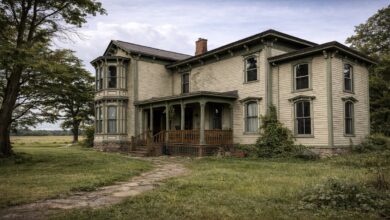
Borley Rectory was constructed in the 1860s as a residence for Anglican clergy serving the local parish. Architecturally, it reflected the domestic Gothic revival style common to Victorian religious housing. The building was large, functional, and isolated, set amid fields rather than village center.
Its purpose was conventional. It housed clergy families, supported parish duties, and functioned as a private home. For decades, it attracted little attention beyond its immediate community. Similar human responses to silence and environment appear in old Changi Hospital.
Nothing in its construction or early use suggested notoriety.
Early reports and informal accounts
Accounts of unusual occurrences began to circulate in the late nineteenth century. These reports were informal, inconsistent, and largely local. They included descriptions of unexplained sounds, moving objects, and fleeting visual impressions.
Such accounts were not uncommon in large rural houses of the period. Drafts, settling structures, and isolation often produced sensations that residents struggled to explain.
At this stage, Borley’s reputation remained limited and undefined.
Media attention and investigation
Borley Rectory entered wider public awareness in the early twentieth century through the involvement of investigators and writers who documented reported experiences. Articles and books presented Borley as exceptional, framing it as a site of repeated and varied unexplained activity.
These publications amplified attention dramatically. Once labeled, the rectory was approached differently. Visitors arrived expecting something unusual. Observations were interpreted within an established narrative.
Media exposure transformed private accounts into public identity.
Disputed methods and credibility
From the outset, Borley’s investigations were controversial. Critics questioned the reliability of witnesses, the conditions under which reports were gathered, and the role of suggestion.
Some accounts were later challenged or retracted. Others were shown to be embellished or poorly documented. Disagreement emerged not over whether stories existed, but over how they should be interpreted.
Borley became a case study in methodological dispute rather than consensus.
Architecture and isolation
The rectory’s physical environment contributed to perception. Large rooms, long corridors, and minimal lighting created strong contrasts of sound and shadow. The surrounding countryside limited external reference points.
Isolation intensifies awareness. In such settings, ordinary noises gain prominence. Movement feels amplified. Nighttime perception narrows.
These environmental factors shaped experience regardless of interpretation.
Occupants under scrutiny
Families who lived at Borley found their private lives increasingly subject to public attention. Personal experiences were scrutinized, recorded, and debated.
This scrutiny altered the relationship between residents and space. When one expects observation or documentation, perception shifts.
Borley’s atmosphere was shaped as much by attention as by structure.
The rectory’s destruction
In 1939, Borley Rectory suffered fire damage. Shortly afterward, the remains were demolished. The site was cleared, and no attempt was made to rebuild.
Physical erasure might have ended the story. Instead, it intensified it.
With the building gone, debate shifted entirely to records, memories, and interpretation.
Presence without structure
Unlike preserved sites, Borley exists only through documentation. There are photographs, floor plans, letters, and conflicting testimonies.
This absence of physical reference makes the narrative more abstract. Without walls to measure or corridors to walk, interpretation becomes unanchored.
The rectory persists as an idea rather than a place.
Why the label endured
The phrase most haunted house in England persists because it was repeated, contested, and defended over decades. Dispute kept attention active.
Each challenge produced response. Each rebuttal reinforced awareness.
Borley’s reputation survived because it was never resolved.
Absence as amplification
Demolition removed the possibility of direct experience. No one can now test acoustics, light, or scale firsthand.
This limitation amplifies reliance on secondary sources. Stories become definitive by default, not verification.
Absence strengthened narrative.
Cultural appetite for unresolved sites
Borley emerged during a period of heightened public interest in unexplained phenomena. Newspapers, books, and radio expanded reach rapidly.
The rectory fit cultural expectations. A rural setting, religious context, and domestic scale aligned with popular imagination.
Borley became a reference point rather than a location.
Skepticism and reassessment
Later reassessments questioned earlier conclusions. Scholars and critics highlighted inconsistencies, bias, and lack of controls.
These reassessments did not erase Borley’s reputation. They reframed it.
The rectory shifted from proof to problem. From example to debate.
Memory over material
Borley demonstrates how memory can outlast material presence. The site today offers little visual evidence. Yet discussion continues.
This endurance reveals how narrative attaches to place independently of structure.
The rectory is remembered not for what remains, but for what was said to occur.
Comparison with other demolished sites
Many demolished buildings vanish from memory quickly. Borley did not because it was documented intensely before destruction.
The volume of record preserved it. The conflict within those records sustained interest.
Borley became an archive rather than a ruin.
Fear, fascination, and restraint
Modern interpretation approaches Borley with greater restraint. The focus is on historical context, media influence, and psychological factors.
Fear is no longer central. Analysis is.
This shift reflects broader changes in how such sites are understood.
Why Borley still matters
Borley matters because it illustrates how reputations form, persist, and detach from physical reality. It shows how attention and expectation shape experience.
The rectory’s story is not about what cannot be explained. It is about how explanation is constructed and contested.
Its legacy lies in discourse, not evidence.
A site defined by dispute
Borley Rectory’s defining feature is disagreement. There is no single accepted account. No final interpretation.
This lack of closure keeps the story active.
In absence of resolution, narrative continues.
Between belief and documentation
Borley occupies a space between belief and record. Some accounts were sincere. Others were flawed. Together, they form a complex picture.
The rectory does not demand belief. It demands careful reading.
Understanding Borley requires acknowledging uncertainty without filling it prematurely.
A place that remains through story
Today, Borley Rectory exists as coordinates, photographs, and pages. The field where it stood is quiet.
Yet the name remains active in cultural memory.
That persistence demonstrates the power of unresolved accounts.
Conclusion without walls
Borley Rectory was once labeled the most haunted house in England. The building is gone, but the label remains.
Its presence now exists entirely through narrative. Disputed, analyzed, and revisited, it continues to shape discussion without physical form.
Borley stands as an example of how absence can intensify memory. When walls fall, stories sometimes stand taller. Related reflections on memory and perception can also be found in Château Miranda.
Horizon Report documents places shaped by memory, infrastructure, and human decisions. Our editorial approach focuses on what remains physically visible, how abandonment unfolds over time, and how interpretation is clearly separated from observable evidence.
For readers seeking deeper context, the following background articles explore how ghost towns emerge, why communities are left behind, and why preservation matters in understanding collective history.
- Abandonment And Ghost Towns
- What Is A Ghost Town
- Why Towns Are Abandoned
- Preserving Abandoned Places
Editorial transparency matters. Observations are grounded in site layout, materials, remaining structures, and documented timelines where available. Interpretive layers are presented as interpretation, not assertion.
Careful readers often notice details worth refining. Thoughtful feedback helps ensure accuracy, clarity, and long term editorial integrity.